A Real Example of Energy Transition: How a Luxemburgish Household Stepped Into the Future of Solar
Good news for anyone considering a photovoltaic installation in Luxembourg: the journey toward energy independence can be smoother, faster, and more rewarding than you might think.
One of our clients, living in Schuttrange, recently demonstrated exactly how impactfull a progressive approach to solar, storage, and smart energy management can be. Their story showcases how each investment step brought measurable benefits — from lower bills to greater autonomy.
This case study focuses on a single-family home built in 2011, equipped with a heat pump and two electric vehicles, whose energy consumption serves as the basis for the analysis.
The house initially had a reference power* of 12 kW in 2025. Improved load distribution—made possible in particular through the e_productivity HEMS (Home Energy Management System)—enabled the grid operator to reduce this value to 7 kW as early as 2026.
Below is an overview of their transformation.
Before Solar: A Situation many Households know well
No solar production:
- full dependency on the grid
- exposure to rising energy prices
- inability to optimise consumption
- significant carbon footprint
First Installation: 12 kWc Photovoltaic System
Self-producing a substantial share of daily consumption.
Decreased grid dependency.
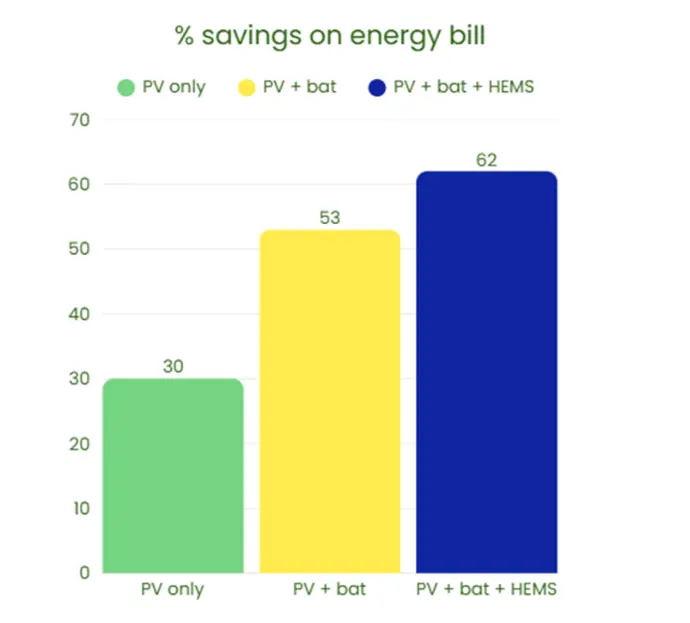
30% reduction of energy bill
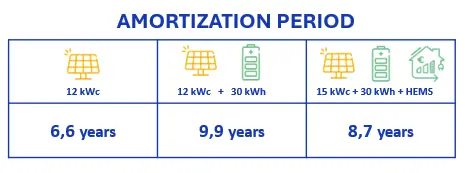
6.6 years expected payback period
Addition of 30kWh Battery
Storing excess production rather than reinjecting it at a low tariff.
Immediate advantages:
- higher evening self‑consumption
- stronger monthly savings
- considerably reduced grid imports
53% reduction of energy bill
9.9 years expected payback period
Upgrade: 15 kWc + Battery + HEMS
Benefits observed:
- maximised self‑consumption
- lower reliance on the public grid
- power limitation penalties avoided
- reduce the reference power value
- automated optimisation based on weather forecasts and consumption patterns
- improved comfort
62% reduction of energy bill
8.7 years expected payback period
A Clear Success Story — And a Model for Future Customers
Their progression — starting with basic PV, then adding storage, and finally adopting a full smart‑energy setup — shows that the transition can be gradual, affordable, and immediately beneficial.
Why This Example Matters
This Use case demonstrates that:
Every step brings clear financial and ecological gains.
Subsidies and incentives make the investment far more accessible.
Smart energy systems are no longer a luxury — they’re a practical solution for every modern household.
Your own project can follow the same path, tailored to your needs, your budget, and your long‑term goals.
We’re here to guide you from planning to installation, ensuring a smooth and transparent process at every stage.
*At Creos (the electricity and natural gas grid operator in Luxembourg), the reference power corresponds to the maximum electrical power, expressed in kW, used since 2025 as the basis for calculating the fixed fee and the network tariff.